
Stories that Matter
Reflections on Martin Shaw's Summer School

A Pair of Parables
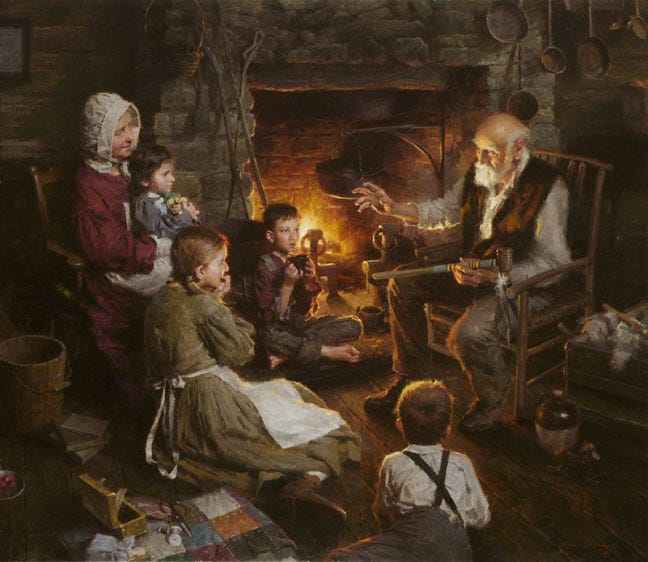
Truth was tired and discouraged. He had been travelling around, knocking on doors and trying to talk to people. But anyone who saw him coming turned the other way and fled. People seemed ashamed and afraid of him, and they didn’t want anything to do with Truth.
One day, as Truth was huddled alone in the doorway of a ruined house, Story came by. Story was an old friend of Truth, but unlike Truth he wore brightly colored clothes and was welcomed everywhere he went. He saw Truth sitting miserably in the doorway and went over to find out what was wrong.
Truth told him that no one welcomed or listened to him. He was too old, he said, and people just hid their eyes or turned their backs on him when he tried to talk with them. There was no point in trying to meet people anymore, and the only thing left to him was to sit alone away from any companionship.
“Nonsense!” said Story. “You just need to change your approach. You’re right, people don’t want to hear Truth directly, but here, take my coat, and see what happens. You’ll find that people will want to hear what you have today.”
Truth was skeptical, but he put on the coat of story and went out. At first he approached people hesitantly, thinking he would be rebuffed, but everyone was interested and even eager to hear what he had to say. He was welcomed in the streets, in the town squares, and in people’s homes. Because, it turned out, people were not interested in the naked Truth but they were eager to hear Truth wrapped in Story.
This is a rabbinic parable first told by Yankev Krantz, the Maggid of Dubno, Ukraine. (A Maggid is a storyteller and a preacher.) I first heard it on Sunday, July 12, of this year in a church service in St. Michael’s Mount, Cornwall. My wife and I were touring the castle, which is still occupied by the family that owns it. As we entered the castle proper, we heard there was going to be a church service in five minutes. We asked if we could attend, and so we ended up getting the last two seats in the chapel.
When the priest began his homily with this story, I thought it was a remarkable synchronicity. The next day, Lynn and I were going to drive to Devon for Martin Shaw’s Summer School on myth and storytelling.
Martin opened Summer School with another rabbinical story:
A crisis came to a community, and so the elders lit the sacred flame, went to the sacred grove in the woods, and performed the ritual prayers. A few months later, things got better.
Sixty years later, there was another crisis. They had forgotten how to light the sacred flame, but they went to the sacred grove and performed the prayers. A few months later, things got better.
Decades later, another crisis arose. They had forgotten where the sacred grove was, but they still performed the prayers. A few months later, things got better.
Then decades later, there was yet another crisis. This time, no one remembered the prayers. Someone simply said to God, “I do not know how to light the sacred flame or where the sacred grove is; I do not even remember the prayers. All I can do is tell you the story.” And a few months later, things got better.
It turns out, God loves a story.
Over the next few days, Martin Shaw told us stories coming from cultures from Ireland to Siberia and gave us storytelling tips and exercises. Along with the stories, he gave us questions to help us understand what the story might be saying to us personally. More on that shortly.
History and Storytelling
Listening to the stories and the things he asked us to think led me to ponder the difference between the stories that I told as a historian and the kinds of stories Martin Shaw tells. A lot of my students had bad experiences with history teachers and thought that history was all about names and dates. I would tell them that those kinds of things weren’t what history was any more than the periodic table was what chemistry was. Rather, just like the periodic table was the raw material that chemists use in their research, names and dates are the raw material historians use in their work. As an academic historian, I would tell them that history isn’t so much about what happened as why it happened.
Of course, that means you have to know what happened.
So when I taught, I would use stories whenever possible. Most of these were historical, but sometimes I would tell personal stories as well. I had several reasons for this. The stories illustrated the points I wanted them to learn; if I could supply them with a colorful story, they were more likely to remember it. The personal stories sometimes highlighted points from the lecture, but I also used them to try to establish a connection between me and the students. And frankly, like God, I just like stories.
The stories Martin Shaw tells aren’t like the stories I told. Some are jokes or humor, but many are drawn from myths, sagas, legends, folktales, and fairytales. Unlike my stories, they are not concerned about facts; they rely far more on the imagination of both the storyteller and the listener. They are also open-ended. They survived the centuries because something in the story resonated with people across cultures and eras, but this was not typically a specific lesson. Even in fairytales, there is more going on than just the “moral” of the story. Often, seemingly small elements in the stories might be enormously significant to different individuals and cultures. Thus, the story speaks to different people in different ways. And so after telling a story, Shaw will ask questions to help his hearers ponder the story’s message to them.
Hearing the Message
For me, this was the difficult part of Shaw’s teaching. I am used to listening to stories to remember the details and reproduce them, and I am good at that. But learning to go beyond that, to ask what the story is saying to me is a different matter. I am used to consuming stories as simply stories or for the worldview they espouse without probing for deeper meanings, and my historical stories reinforced this tendency. A major reason for me to go to Shaw’s Summer School was to start learning how to do this. Honestly, I made some progress, but I still have a long way to go.
The best analogy I can come up with for how Shaw approaches stories is Jesus’ parables: we know that these aren’t about the surface meaning but that the story points beyond itself to spiritual truth. But we are looking for “the” point (singular) of the parable. But the history of the interpretation of the parables shows that they are more open-ended than that. For example, people of different eras have drawn out different lessons from parables like the Good Samaritan and the Prodigal Son.
Traditional tales function like parables: they have deeper significance than just the surface events. In an earlier article, I mentioned an ancient Athenian who memorized the Iliad and the Odyssey because his father told him it would make him a better man. It isn’t the plot that does that: his father expected him to learn lessons about life from the story. We don’t typically know how to read Homer that way.
Bigger Stories
Compared to my stories, Martin Shaw’s are bigger: They have vastly more far-reaching implications. There is, of course, a place for both kinds of stories; they serve different purposes. But for re-enchantment, the kinds of stories Shaw tells are invaluable. As Shaw points out, I don’t know anyone who doesn’t like a good story (even God!). Myth, folktale, fairytale, all engage the imagination—the organ of meaning, as Lewis reminds us—and so can sneak past the watchful dragons of cynicism and skepticism and help us recover a sense of meaning in the circumstances of our lives.
As the story of the Naked Truth tells us, Truth is best received when clothed in story.
But we need to learn to go past the plot, to ask questions of ourselves and of the stories if they are going to have the impact on our lives that they could have. I’ve got a lot to learn about this, but I will be sharing what I learn in future articles.
Truth wearing the cloak of story. That was a wonderful parable, and seems to have a glimpse of the incarnation in it. The Word became flesh. Christ wearing humanity.
If the prophet Nathan simply came up to David and confronted him about the his adultery with Bathsheba and the murder of Uriah, then David, in his guilt, most likely would have acted in anger and hardened his heart. Perhaps Uriah would have been hearing the story from Nathan directly.
Instead, Nathan put on the cloak of story which ignited David’s anger against the guilty party, only then revealing to David that he was the guilty man in the story. Once David was removed from the events and saw good and evil from the perspective of an onlooker he was able to fully participate in the story and let it do it's work on his soul. Only then he was able to realize his own guilt and repent.
I’ve been reading a lot by Ian McGilchrist concerning left hemisphere right hemisphere and can see how that impacts what we get out of a story. We need to improve using out right hemisphere. I know I do
Excellent article.