
The Church Year
Rediscovering Sacred Time


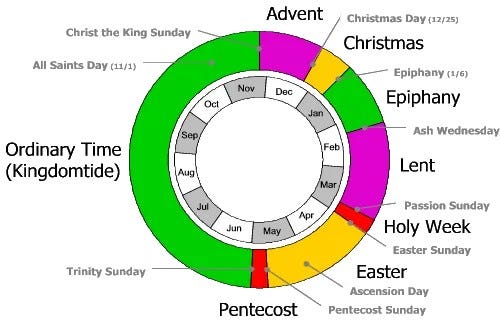
The church year has been an important way of rehearsing salvation history and sacralizing time for most of church history. While some traditions include many more commemorations than others, the four major holidays (Christmas, Epiphany, Easter and Pentecost) at the very least have been recognized by nearly all major branches of the church. We’ll get to the exceptions later, but let’s start with understanding how the calendar developed.
The Date of the Crucifixion
Everything begins with the date on which Jesus was crucified. We know it was the Passover, 14 Nisan on the Jewish lunar calendar. The problem was how to convert this to the Roman solar calendar. The majority view was that it was March 25, though a minority thought it should be April 6. Keep that in mind—we’ll come back to it.
The question then became how to commemorate the day. Should we follow the Jewish calendar and celebrate Jesus’ death on the Passover and His resurrection on the Feast of First Fruits (the day after the first sabbath after the Passover)? But by this point the church was majority Gentile and they weren’t getting along very well with the Jews; further, it spread the distance between the Crucifixion and Easter beyond the third day emphasized in Scripture and the creeds. So the decision was made to celebrate Easter on Sunday and then lay out the events of Holy Week (Palm Sunday, Maundy Thursday, and Good Friday especially) accordingly.
Easter and Pentecost
But then, how do you determine the date of Easter? In the Western Church, there were a few different ways of calculating it, but they eventually settled on the first Sunday following the first full moon after the Vernal Equinox.
The Feast of the Ascension comes on the fortieth day of the Easter season, and Pentecost on the fiftieth day. This is the Sunday beginning the eighth week after Easter. Eight is an important symbolic number representing new creation, but discussing that would take us too far afield for present purposes.
Christmas, Epiphany, and Related Dates
Next, we needed to determine a date for Jesus’ birth. As early as the second century, Christians began trying to identify this. A variety of dates were suggested, but in the end, the church settled on a date determined by Jesus’ death. The Jews believed that important events happened on the same dates. For example, we know Israel entered Egypt on 14 Nisan and left on that date (Exodus 12:4-41); the Jews believed this was also the date when Abraham was called and Isaac was sacrificed. Some Jews believe that especially godly people die on that date. They also believed that important people entered the world (i.e. were conceived) on the same date they died.
This means that Jesus was conceived on 14 Nisan, or March 25 in the Roman calendar. This is thus the Feast of the Annunciation. Nine months later puts us at December 25, and so that was established as the date of Christmas. (St. John’s Day, the commemoration of the birth of John the Baptist also follows from this: Elizabeth his mother was six months pregnant at the Annunciation, so St. John’s Day is 3 months later at June 25.)
Those who believed the Crucifixion was on April 6 dated Christmas to January 6. For the rest of the Christian world, this became the Feast of Epiphany, which in the west primarily commemorates the arrival of the Magi; in the Orthodox world, the holiday’s focus is either on Jesus’ baptism or on the wedding at Cana. Christmas celebrations only began on Christmas and lasted for the twelve days until Epiphany, which gives us the Twelve Days of Christmas. This is radically different from secular culture, which has Christmas parties predating the holiday and throws out the Christmas trees the day after.
You may have heard that Christmas was dated on December 25 to compete with the Roman holiday of Saturnalia. The earliest claim of this comes from the ninth century, or many centuries after the date of Christmas was established. The alternative date for Christmas (January 6) and earlier sources show that the date was influenced by Judaism, not paganism.
Jesus was circumcised on the eighth day, so that is remembered on the eighth day of Christmas, January 1. This is serendipitous: January is named after Janus, a Roman god with two faces looking forward and backward. Jesus’ circumcision looks back to God’s covenant with Abraham and to the Old Testament Law while looking ahead to Jesus’ work fulfilling the Law and bringing in the New Covenant.
February 2, forty days after Christmas is the Feast of Candlemas . This commemorates Mary’s purification after the birth of Jesus and Jesus’ presentation in the Temple. Its name comes from the tradition of bringing candles to church for blessing on that day.
So this was the process for establishing the dates for the four major holidays of the church year (Christmas, Epiphany, Easter, and Pentecost), plus other New Testament events around them. But we’re not done yet.
The Seasons of Lent and Advent
The church believed that it was important to have a period of fasting, self-examination, and repentence prior to the celebration of Easter. This is the season of Lent. The church decided that this should be 40 days long in imitation of Jesus’ fast in the wilderness. Exactly how the forty days was calculated is complicated and varies between the eastern and western churches. Suffice it to say here, in western churches it begins on Ash Wednesday, doesn’t include Sundays (which are always in principle feast days since they commemorate the Resurrection), and continues through Holy Week; in eastern churches, you don’t get Sundays off, Lent ends on Lazarus Saturday, but then you have a series of other fast days until Easter.
The season of Advent was created in imitation of Lent as a time of preparation for celebrating Christmas. In the Orthodox church and in some of the old Celtic churches, Advent lasts 40 days, starting on November 15; in the western churches, it begins on the fourth Sunday before Christmas.
Advent reminds us of the people of Israel who waited with longing for the coming of the Messiah; it also reminds us that like the ancient Israelites, we are waiting and longing for Jesus’ return. It is thus historically a fasting season up until Christmas Vigil as we “mourn in lowly exile here until the Son of God appear” in the words of “O Come, O Come Emanuel.” Given the secular world’s early celebration of Christmas, few western Christians keep this as a fast, though the Orthodox still do.
Recapitulating Salvation history
Advent is the beginning of the church year. As we look at its structure, we discover that it tells the story of salvation history. Advent is the time prior to Christ when God’s people were waiting for His coming. Then we celebrate His birth, and with Epiphany His baptism and the beginning of His ministry. The focus on His ministry continues through the events of Holy Week and Easter. We then celebrate the Ascension and Pentecost, the birth of the church. The rest of the year up until the final Sunday before Advent reminds us of the history of the church.
In the western church, Christ the King Sunday is the final Sunday before Advent. This day celebrates the already-but-not-yet reality of Christ’s kingdom, recognizing that He is already king over all things and has begun to reign, while at the same time looking forward to His kingdom coming in its fullness. The church year thus begins with the Old Testament saints waiting for Jesus’ coming and ends with acknowledging the present reality of Jesus’ kingdom while looking for its arrival in its fullness.
This year, Christ the King Sunday is November 23, next Sunday.
Ordinary Time and Other Holidays
The periods from Epiphany to Ash Wednesday and from Pentecost to Advent are “ordinary times.” The name comes from “ordinal,” or counted, because the Sundays are numbered: the first Sunday after Epiphany or Pentecost, the second Sunday after Epiphany or Pentecost, and so on. There are no major feasts during these periods.
Some traditions add other dates into the calendar, such as saints’ days which generally occur on the date of the saint’s death, when they entered heaven, or holidays such as All Hallows Eve/All Saints’ Day/All Soul’s Day. Some of the better known of these days are St. Patrick’s Day (March 17), Trinity Sunday (the Sunday after Pentecost), Michaelmas, or the Feast of St. Michael and All Angels (September 29), and Martinmas, which commemorates St. Martin of Tours (November 11). With or without these days, however, the recurring sequence of the church year reminds us of and invites us to participate in sacred history as our own story and thus rediscover our lost sense of sacred time in our own lives.
Traditions that Do Not Use the Church Year
Not all Christian traditions follow the church year as I’ve outlined it above. Catholics and Orthodox do with some variations between them, as do Anglicans and Lutherans, though in a more limited way. Continental Reformed churches tended to strip it down to the three holidays, Christmas, Easter, and Pentecost. Most of these churches celebrated communion on these three dates along with the first Sunday in September.
This is not far from how Evangelicals tend to treat the church year: they recognize Christmas and Easter, maybe Holy Week, and sometimes Pentecost. Some of this undoubtedly comes from the culture’s recognition of Christmas and Easter but nothing else in the church calendar. In general, Evangelicals do not typically see the world, including the calendar, as having spiritual significance. The Gospel is about personal salvation and morality; its focus is on the world to come. This is a thin vision of the Gospel. Jesus tells us that all authority in heaven and on earth has been given to Him. This means that the Good News of the kingdom applies in the here and now, in this world, not just in the next. As the Alpha and Omega, Jesus is lord not just of space but of time as well. Following the church year at least in terms of the major seasons and feasts is a way of living this out and letting the full history of salvation imprint itself on our minds and hearts through enacting it annually.
Canceling Christmas?
Back to the Reformation period, the English Puritans and the Scottish Presbyterians did not follow their continental Reformed counterparts in recognizing Christmas, Easter, and Pentecost. They rejected Christmas as well as Epiphany and essentially ignored Easter and Pentecost, treating them just like any other Sundays. They argued that God had mandated worship on the Lord’s Day, which replaced the Saturday as God’s Sabbath, and that having annual celebrations not commanded in Scripture would inevitably lead people to treat those holidays as more important than the weekly Sabbath that God commanded.
Further, like their continental counterparts, they held to the regulative principle, which says we must not do anything in worship except what God expressly commands. This is based on their reading of the Second Commandment as counted by the Protestants (“do not make a graven image….”), which the Reformed understood as prohibiting any form of worship of God that He did not authorize in Scripture. The continental reformers did not think Christmas violated this, but the Puritans and Scots argued that since there was no mandate in Scripture to celebrate Christmas, doing so would constitute false worship.
That at least was the excuse they gave. I suspect the real reason was that they objected to the kind of excessive revelry and disorder that accompanied Christmas celebrations in England. This led them to conclude that celebrating it was sin. They thus adopted a more restrictive interpretation of the regulative principle than was held on the continent to justify banning Christmas. In other words, the regulative principle was an ex post facto justification for what had its origin in discipline, not theology.
A More Balanced View
What does this mean for Reformed use of the church calendar? While I agree for the most part with the regulative principle, I think using it to abolish the church year is overly restrictive. God didn’t have problems with feasts in the Old Testament period along with the Sabbath. In fact, He commanded many to be celebrated and even allowed new feasts such as Purim and Hannukah (a.k.a. the Feast of Dedication) to be added to the calendar without explicit divine authorization. And if you have questions about that, consider that Jesus Himself participated in the Feast of Dedication (John 20:22ff). In the British Reformed reading of the regulative principle, that would have constituted false worship. To my mind, this shows that their understanding of the regulative principle goes well beyond its usefulness as a guide to proper worship.
In view of the precedent set by God Himself, I see nothing wrong with celebrating the key events in our salvation history—in fact, I think it is a very good idea given the way God ordered and permitted such commemorations in the Old Covenant. I don’t think they are mandatory, but I think they are very valuable as an annual reminder of the story of our salvation, a participation in that story, and a way to recover a sense of sacred time that has largely been lost in our secular world.
The regulative principle, while a helpful tool, I think too often is overly restrictive and over the top. The Old Testament is filled with Jewish celebrations, often days long, which have a main purpose... to REMEMBER what God has done and to CELEBRATE His Majesty and sovereignty. These types of celebrations should be embraced by Reformed evengelicals, not rejected as "graven worship".
Thank you so much for this. I have Mennonite and Dutch Reformed Friends and I was just trying feebly to explain this to them. You do a much better job! I’m a new Anglican and I love the liturgical calendar instinctively but it’s wonderful to have it explained. I asked and I received. 🙏🏻