
Twelfth Night
The Last Day of Christmas and the Arrival of Epiphany

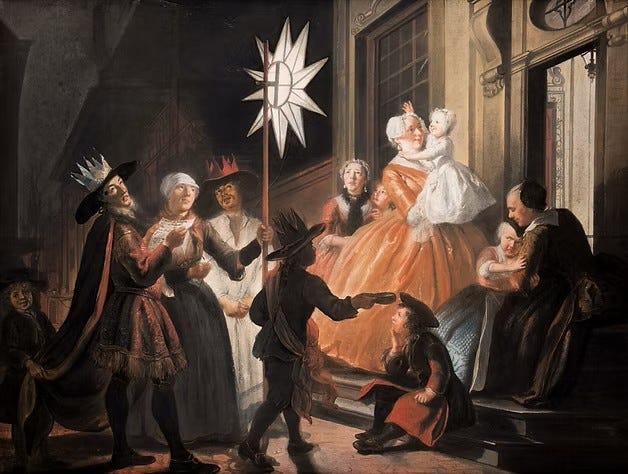
We have arrived at the twelfth and final day of Christmastide. It is Twelfth Night, the climax of the Christmas season in the Middle Ages.
Many traditions surround the celebration of Twelfth Night. Some of these which connect it to the next day’s Feast of Epiphany when western Christianity celebrates the arrival of the Magi in Bethlehem. In these ways Twelfth Night can be considered Epiphany Eve, with as close a connection to Epiphany as Christmas Eve has to Christmas.
Gift Giving
Historically, Twelfth Night was the time when gifts were given, inspired by the gifts the Magi gave to the Christ Child. Oddly from our perspective, gifts were usually given by underlings to their patrons rather than the other way around. The reason for this is that the Magi, even understood as kings, gave gifts to the One who was their superior. At least that was the justification for the practice. Whether that was really the motivation or whether it was another way for the powerful to shake down their clients is a matter for you to decide.
The exception was gifts for children, which were given on December 6, St. Nicholas Day. With the advent of Protestantism, however, this began to change. Martin Luther objected to celebrating Saints’ Days, including St. Nicholas Day, and so he promoted giving gifts to children “from the Christ Child” (Christkindl) on Christmas day. This practice spread in Protestant areas and had the effect of gradually shifting other gift giving forward from Epiphany.
The Victorian era saw a decisive shift to giving gifts on Christmas in the Anglophone world, largely due to the German Prince Albert, who also brought Christmas trees to Britain. Twelfth Night and Epiphany celebrations waned in Britain, though in other areas historic traditions continued. And in some Catholic and Orthodox countries, major gift giving still occurs on Epiphany.
Twelfth Night Cake, or Three Kings Cake
Also related to the Magi were elaborate cakes prepared for Twelfth Night. In Britain, a dried bean was baked into the cake, and the man who got the piece with the bean in it was crowned king for the night and was then in charge of the evening’s revelry. Sometimes a dried pea was also included, and the woman who got that piece was the queen.
Other countries had and continue to have similar practices for identifying Epiphany’s king. In France, galettes des rois in the north and gâteaux des rois in the south have a figurine baked into them. In Germany and Swizerland, Dreikönigskuchen have either an almond or a figurine in them. In Spain and Latin America, roscan de reyes or rosca de reyes contain two items: a figurine to designate the king and a bean to identify who is to buy next year’s cake and host the celebration. The Portuguese bolo-rei similarly has a good luck trinket as a prize and a bean for next year’s cake.
The Lord of Misrule
Returning to England, Twelfth Night also saw role reversals and social inversions presided over by the “Lord of Misrule,” often a commoner. Masters would serve their servants, men might dress as women, and in general, social hierarchies were flipped for the day. On the continent, the Feast of Fools on January 1 (the Feast of the Circumcision) likewise was a time of social inversion.
These practices were a way to let off some steam in the deepest part of the winter by allowing a time of chaos before normal order resumed. We see similar practices associated with Boy Bishops (an inversion of the clerical hierarchy) on St. Nicholas Day in England, and in Carnival, the period immediately before the Lenten fast, in other parts of Europe.
Not surprisingly, things could get pretty rowdy with the Lord of Misrule. The Puritans opposed the excesses such as drinking associated with Twelfth Night, and during the Commonwealth banned it along with Christmas. The ban was not popular: there were riots in Canterbury over this in 1647, for example. With the Restoration, the holidays were reestablished, but the interruption weakened the traditions and Twelfth Night began to decline in importance.
Wassailing
Wassail (from the Old Norse and Old English toast waes hael, meaning “Good Health”) was a drink made of spiced hard cider, ale, or wine, often with roasted apples or toast floating in it. It was carried in a large bowl from house to house on Twelfth Night accompanied by songs. The wassailers would offer drinks in return for money, treats, or food. The practice largely died out in the nineteenth century and was replaced by caroling.
Another version of wassailing which has been revived in parts of southern England involves carrying the bowl with spiced hard cider to orchards. The wassailers bless the trees for a bountiful harvest by pouring cider on the roots and putting cider-soaked toast in the branches for the birds. They also sing chants and make noise by banging pots, shooting guns, and the like, to awaken the trees and scare off evil spirits. This is typically done on January 17, the old Julian calendar’s Twelfth Night (with Christmas on January 6). The modern version includes bonfires, Morris dancing, and communal cider drinking.
Other Practices
Twelfth Night was also celebrated with games, charades, mumming (a kind of masked folk play), and extinguishing the Yule Log, which had been burning since Christmas Eve. A portion of the log was saved to start next year’s Yule Log. Christmas decorations were also taken down since it was considered bad luck to leave them up.
Although in Europe and Latin America Twelfth Night and Epiphany are still celebrated, in America the holiday along with the Twelve Days of Christmas is largely forgotten due to the commercialization of Christmas. As I’ve noted elsewhere, we consider Advent (and earlier) the Christmas season and end Christmas celebrations within a day or two of December 25. Many churches continue to recognize Epiphany, but aside from those with Latin American roots celebrating Three Kings Day, there is little wider cultural recognition of the holiday.
While we might question the rowdier aspects of the celebration of Twelfth Night, I think there is genuine value in celebrating the Nativity for the full twelve days of Christmastide. Doing so requires being countercultural, resisting the pull of Christmas into Advent and its premature end before Epiphany. This is a way of sacralizing time and joining with the historic traditions of the church as a means of resistance to the modern world’s attempt to secularize and commercialize the commemoration of our Savior’s birth.
But that is for next year. Tomorrow is Epiphany and the start of Epiphanytide. Different traditions handle this in different ways. For some Anglicans and Lutherans, it ends on Candlemas (February 2); for other Protestants who recognize the season, it lasts until Ash Wednesday; for modern Roman Catholics, it is simply the first period of “Ordinary Time” in the liturgical year and lasts again until Ash Wednesday. I will be looking at some of these turning points in the liturgical calendar in future posts.
Wonderfully written!!
T H AN K YOU!