
All About Angels
What the Bible and Church Tradition Says about Them

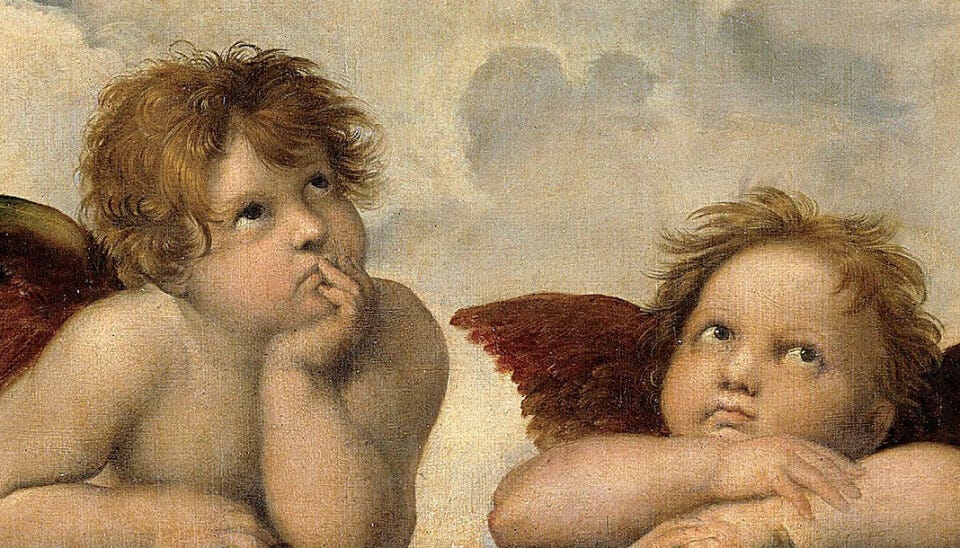
In the past year or so, I’ve written articles on demons (here) and several on the Nephilim (here, here, and here). I will probably need to revisit the issue of demons and evil spirits at some point, but here, I’d like to take a look at angels.
Some Preliminaries
To understand angels, we need to begin with a basic point that we often miss. We tend to draw a line between the physical and the spiritual world, with God, angels, and demons inhabiting the latter.
This is a fundamental mistake.
Biblical metaphysics draws the line between God the Creator and everything else in Creation, including angels and demons. This means that in creation, we have more in common with the Four Living Creatures of Revelation 4 or the cherubim in Ezekiel 1 than we have with God—we are all finite, contingent, created beings, but God is infinite, necessary, and the uncreated Creator.
Christ’s Incarnation changes this—God now shares in our nature and so in Christ we have more in common with God than the seraphim, cherubim, or any other beings in the invisible realm. That’s an amazing truth that explains why angels are here to serve us (Hebrews 1:14) and that we will ultimately judge them (1 Corinthians 6:3).
The created world has two sides: the visible and the invisible. The invisible permeates the visible, and the two influence each other since they are all part of the same creation.
Angel Basics
This brings us to angels. The biblical terms for “angel” in both the Old and the New Testament (Hebrew malak and the Greek angelos) mean “messenger.” The word is used in two ways. In the narrow sense, angels are created beings who act as messengers and carry out God’s purposes in the world. In the broader sense, it is a generic term for spiritual beings who are or were divine attendants in the heavenly court.
There are a few things in that definition that I should clarify. First, the term spiritual has traditionally been taken to mean non-corporeal. Although angels are in specific places, the assumption has been that they have no bodies. However, it is clear from Scripture that angels can take on physical bodies. They are with Abraham, seized Lot and pulled him indoors, took Lot and his wife by the hand as they lead them out of Sodom, prepared food for Elijah, and kicked (“struck”). Peter to wake him up (Acts 12:7). In view of all this, I think we need to be a bit cautious about drawing too sharp a distinction between the physical and spiritual.
Second, I said angels in the broad sense are spiritual beings who are or were divine attendants in the heavenly court. Usually, when we talk about angels, we are referring to the good ones, the ones who are today serving God. But as we look at the different categories of angels, we need to keep in mind that some of them, even high up in the hierarchy, are fallen. They were made to be part of the hosts of heaven, but they chose to go their own way. These make up some, though not all, of the demons spoken of in Scripture.
With those preliminaries out of the way, let’s move on to classifications of angels and what they do.
Classifications of Angels
Second Temple Judaism began developing a hierarchy of angels which included archangels, angels, Watchers, angelic beings over kingdoms and nature, Angels of the Presence such as angels acting in a priestly role in heaven and throne guardians including seraphim, cherubim, ophanim (literally, wheels), and hayyot (living creatures), and other types as well. This helped lay the foundation for New Testament teaching on angels particularly in Paul’s letters.
As we’ll see below, Paul lists quite a few types of angels, but Scripture doesn’t define their roles precisely. The elaboration on Paul’s lists comes from The Celestial Hierarchy, a late-5th or early-6th century work written under the pseudonym of Dionysius the Areopagite, a convert of Paul in Athens. Pseudo-Dionysius, as he’s known to scholars, preserved an older tradition that shows the influence of Second Temple Jewish angelology. Some of the descriptions of the specific ranks of angels are disputed, but the basic structure laid out in The Celestial Hierarchy is plausible and is a likely explanation of Paul’s terminology.
Pseudo-Dionysius lays out nine choirs of angels set up in three triads.
The First Triad
The first triad are angels who serve in heaven, corresponding to the Angels of the Presence in Second Temple Judaism.
Seraphim
The highest order of angels is the seraphim or the burning ones. These are the beings who surround the throne of God in Isaiah 6 and Revelation 4 and who continually proclaim “holy, holy, holy is the LORD God Almighty.”
The depiction of seraphim changed over time. Early on, they were presented as winged serpents parallel to the Egyptian winged uraeus. Numbers 21:6 and Deuteronomy 8:15 reference “fiery serpents” (nahashim seraphim); similarly, Isaiah 14:29 and 30:6 both refer to fiery (seraphim) winged (or dark) serpents.
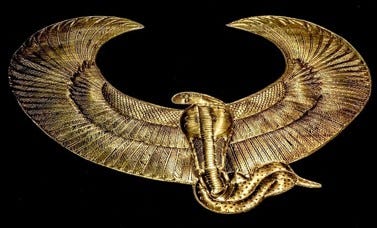
Winged Uraeus (Egyptian)
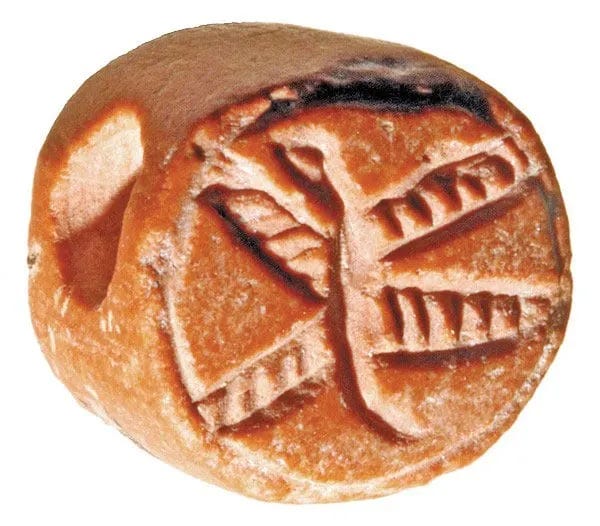
Israelite Seal with Winged Serpent/Seraph
This raises an interesting question about the serpent in the Garden of Eden. Was it a seraph? Does that explain why Eve wasn’t surprised at it talking to her and why she trusted it? Does it explain the judgment on the serpent that he would crawl on his belly, getting his wings clipped as it were? Scripture doesn’t make this identification, but it is an interesting possibility. We do know that the serpent is Satan and the Dragon in Revelation (Revelation 12:9).
Over time, the way seraphim were depicted changed to the six-winged figures we see in Isaiah and Revelation.
Cherubim
The second choir in this first triad are the cherubim. These are throne guardians in heaven and, in Genesis 3:24, the guardians placed at the entrance of Eden after the Fall. It is worth noting that as throne guardians, the cherubim are not protecting God but the unworthy who might attempt to approach God’s throne; similarly, the cherubim guarding Eden was protecting people from accessing the Tree of Life and so living eternally in sin and misery.
Cherubim were originally depicted as winged sphinxes or winged bulls with human heads as was common to throne guardians in other cultures in the ancient Near East.
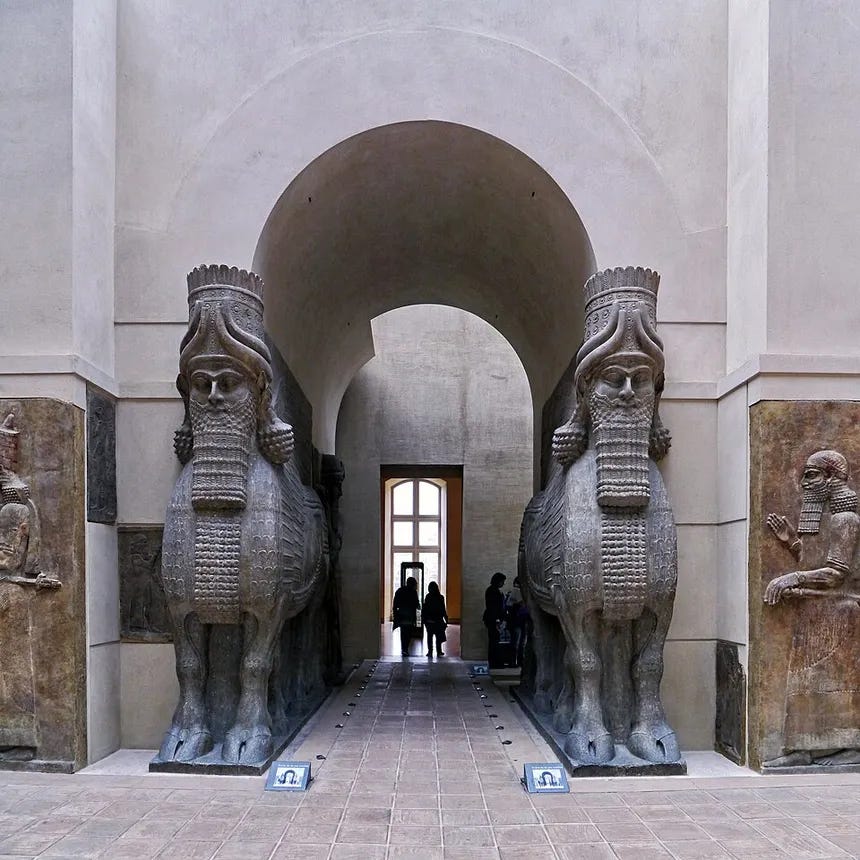
As had happened with seraphim, the image of the cherub changed over time. Thus, in Ezekiel, they are humanoid but have four wings and four faces (a lion and a bull corresponding to their older depictions, and an eagle and a man) with legs like a calf (Ezekiel 1:5-11; note that they are described as cherubim in Ezekiel 10:1). So seraphim have six wings and cherubim four.
In Ezekiel 28:13-14, the Prince of Tyre, the spiritual being behind the city, is said to have been an anointed guardian cherub who walked in Eden. This is often identified as Satan, which would imply that Satan was not a seraph as suggested above. It seems possible to me, however, that this cherub was not in fact Satan but joined him in his rebellion. Tyre was an important city, but hardly the most important even in the Near East let alone the world. Satan may not have been directly involved there. It is also possible that the seraph identification may be wrong and the Prince of Tyre is Satan. We don’t have enough information to come up with a definitive answer.
Thrones
The third type of angel in the first triad are the thrones (Colossians 1:16). Pseudo-Dionysius and some earlier Christian writers identify these with the ophanim, the “wheels within wheels” of Ezekiel 1. (Ophanim comes from the Hebrew word meaning to turn.) These are associated with God’s throne-chariot (Hebrew Merkabah), and so they were considered throne guardians with the cherubim. As such, they are often depicted as winged wheels intersecting other wheels, covered with eyes.
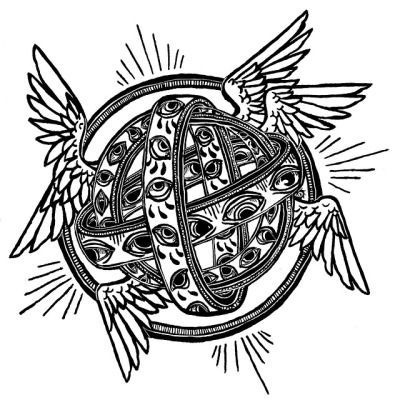
On the other hand, Colossians doesn’t make that connection, so it seems to me possible that it refers to beings like the 24 elders seated on thrones in Revelation 4 and thus part of the divine council. If this is correct, it’s similar to the way we use “throne” to refer to the office of king. Tradition is against me in this interpretation, but again, Scripture does not give a clear definition, so we’ll have to leave it there.
The Second Triad
This takes us through the first triad. The second triad, including the fourth through sixth choirs of angels, involves those who govern the universe, including overseeing lower angels.
The first of these are the dominions (Colossians 1:16). Their responsibilities traditionally include regulating lower ranks of angels and maintaining order. Another possibility that has been suggested is that they are responsible for overseeing large geographic territories on earth above the level of nations.
After the dominions we have the virtues (Ephesians 1:21). The Greek word here is dunamis, a word meaning power and the source of our word “dynamite.” This helps explain what virtues do: they perform miracles, one Greek word for which is dunamis; they grant courage, oversee natural laws, inspire heroic virtue, and infuse creation with divine strength.
The sixth choir are the powers or authorities. The Greek word is exousia, which is the word used to describe Jesus having or teaching with authority. Traditionally, their role is to combat evil forces, protect against demonic powers, and enforce divine justice.
The Third Triad
The third triad, the seventh to ninth choirs, are angels involved in human affairs.
Principalities and Shedim
The first of these are the principalities (Colossians 1:16; Ephesians 1:20-21, 3:10, 6:12). Principalities are the angels who oversee nations. We see these beings referred to in Ezekiel (the Prince of Tyre discussed above) and in Daniel (references to the Prince of Persia and the Prince of Greece, and Michael as Prince over Israel).
In Second Temple Judaism, there was a separate, non-angelic class of supernatural beings who also oversaw the nations. Deuteronomy 32:8-9 says that God divided mankind “according to the number of the sons of God.” (There is a textual variant here, but this is almost certainly the correct reading. See my article on demons for more on this.) The phrase “sons of God” in this verse is bene elohim, which is used consistently in Scripture for spiritual beings. Since these were not part of the heavenly court, they were not considered angels. In verse 17, these are referred to as shedim, translated as demons. In Jewish thought, the shedim fell at Babel in the second great rebellion of spiritual beings against God’s purposes (the first being in Eden).
In 1 Corinthians 10:20-21, Paul says that pagan sacrifices to idols are sacrifices to demons. The idol itself is nothing as taught in Isaiah and the Psalms, but Paul indicates that behind those idols are genuine demonic beings. Now consider what this means. In pagan cultures, the gods exist in a hierarchy, which suggests that the shedim, the gods of the nations, also exist in a hierarchy, with some—the greater and more powerful—ruling over others. It is quite possible that the shedim aligned themselves under the angelic principalities for their own reasons; one way or another, they are following Satan.
Archangels
Although Michael is the Prince over Israel, he is not classified with the principalities but has that position as a special assignment from God, who reserved the people of Israel for Himself. Michael belongs to the next choir, the archangels. The word archangel means a chief angel. The only archangel named as such in Scripture is Michael, though Gabriel mentioned in both Daniel and Luke and Raphael mentioned in Tobit are traditionally named as archangels as well. Uriel is added to the list as a fourth, and sometimes three others of varying names are also included. Each has a different brief.
Michael (“Who is like God?) is the leader of the heavenly armies and the protector of Israel. In Deuteronomy 32, God assigns the nations to the bene elohim but keeps Israel as His own. Michael is then tasked with being the Prince over them (Daniel 10:21, 12:1). In Revelation 12, he leads the angelic armies in casting Satan down from heaven.
Gabriel (“God is my strength”) is a messenger (angel) of God’s who brings particularly important revelations. He is mentioned in Daniel 8:16 and 9:21 and in Luke 1.
Raphael (“God heals”) is a healer and a guide in the book of Tobit. He is the patron of the sick, of healers, and of travelers.
Uriel (“God is my light” or “Fire of God”) appears in 1 Enoch and other intertestamental literature. He is described as the one who warned Noah about the Flood and was in charge of the world and of Tartarus (the deepest place in Hell where the rebellious Watchers are imprisoned). He is also a divine instructor in both 1 Enoch and 2 Esdras.
Four is a number of completion in Scripture, so some accounts of the archangels end here. Seven is also a number that points to fulness and completion, so three other archangels of varying names are also sometimes included. If there’s interest, I’ll cover the various options in a future post.
Angels
The last choir of angels are … just angels. This includes guardian angels (implied in Matthew 18:10 and Acts 12:13-15). These are probably the ones that Hebrews 1:14 tells us are “ministering spirits sent out to serve for the sake of those who are to inherit salvation.” Even angels in this last choir are immensely powerful, and the way they minister on our behalf can be shocking. 2 Chronicles 32:21 tells us that “… the LORD sent an angel who cut off all the mighty warriors and commanders and officers in the camp of the king of Assyria.” 2 Kings19:35 says this happened overnight, and 185,000 were killed. Even today, there are accounts of angels looking like armed soldiers or bodyguards appearing to people planning on attacking believers and scaring them off.
Ockham’s Razor?
The late theologian John Rankin, a good friend of mine, argued that God answers prayer by sending angels. He based this primarily on Daniel 10:10-12, where an angel was sent to Daniel to answer his prayer as soon as it came before God. Whether or not this is true in all cases, it brings up an important point that we in our modern world can overlook. In my experience, most Protestants (except Pentecostals) tend to downplay angels, focusing instead exclusively on God and His power to do whatever He wills directly. As a result, they use Ockham’s Razor and ignore how often angels appear in Scripture. This leads them to extreme skepticism of any account of angelic activity today.
This is a disenchanted way of seeing the world and ignores the many ways God acts through angels in Scripture. Given what it tells us, Ockham’s Razor doesn’t apply.
What we see in Scripture is that both the holy and the fallen angels are very active in this world, influencing nations and people either toward or away from God. Our disenchanted worldviews even in the church are skeptical of any claims that this is still going on, but this is an unbiblical outlook. A properly re-enchanted Christian worldview should at the very least be open to the work of angels, both holy and fallen, in the world around us today.
Thank you again Glenn for this post. I am in the unenlightened crowd concerning angels. This was very interesting and plan to forward this. BTW I loved the videos you did at the recent Colson conference. Is there anyway I could watch those again?
The subject of angels have always fascinated me, and I admit that it can sometimes veer into dangerous territory. When I was a kid -- maybe preschool or early elementary -- I held onto this preposterous idea that angels were higher than God for the sole reason that their aesthetics in artwork are more visually pleasing (fair maidens with wings vs. an old man with long beard is no contest for 3-year-old me).
When I actually started learning basic Reformed theology, I swung to the opposite direction and stopped regarding angels altogether. Tim Mackie from The Bible Project re-introduced me to their reality, and the idea that seraphim were originally portrayed as serpent-like beings and their potential connection to the Genesis 3 serpent stuck with me.
I do think that the excessive preoccupation with angels, demons, and spiritual beings (whom the Bible admittedly don't extensively document about) is more dangerous than the overcorrection, but I am glad for the wonderful richness of this realm that God has allowed us glimpses into.