
Biblical Cryptids?
What to Do with the Mysterious Creatures in Scripture

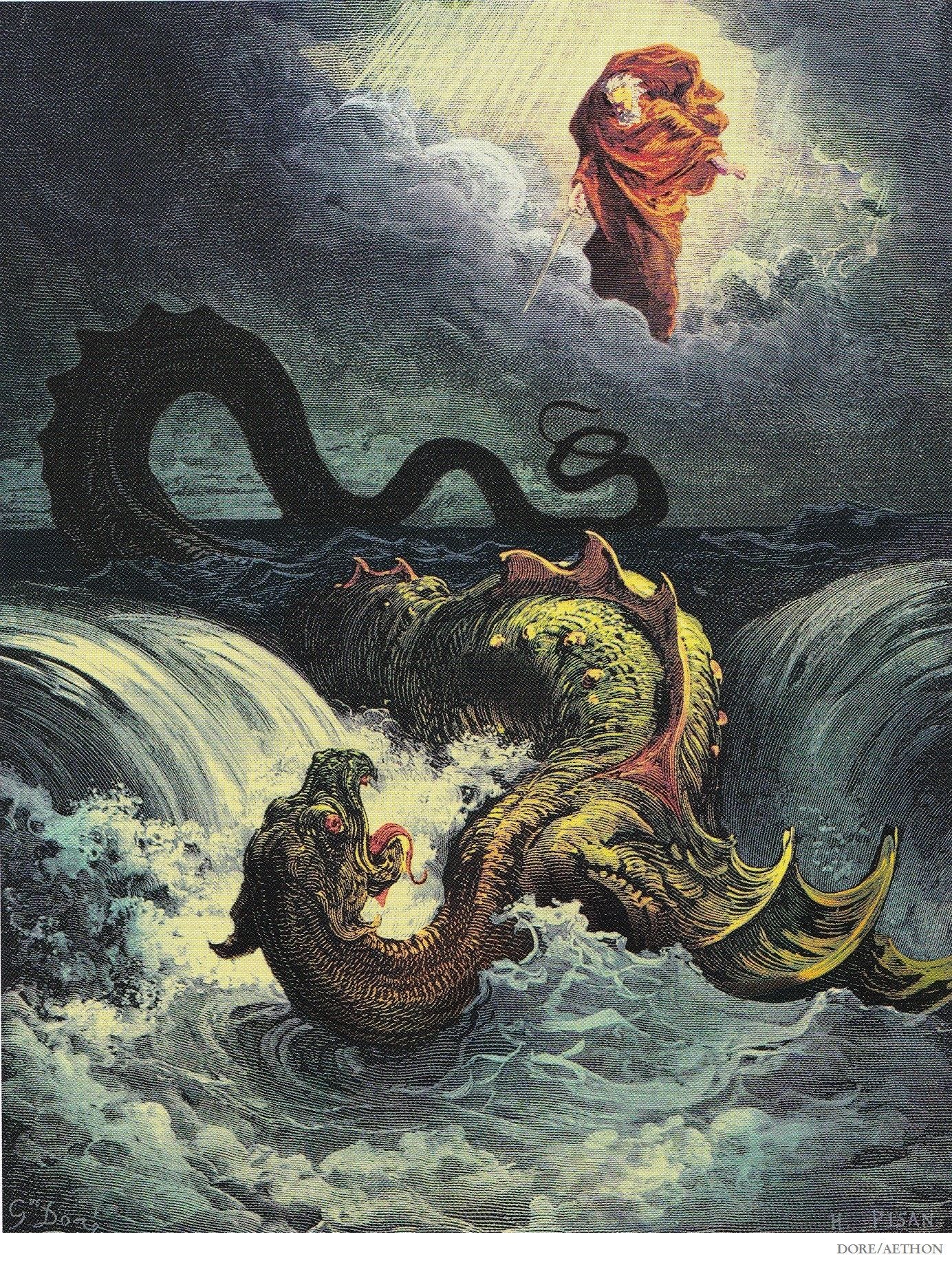
In a previous article, I mentioned that I might do an article on dragons and other biblical cryptids. I got a request to do that, so to wrap up at least for the time being my articles on denizens of the invisible world and related subjects, I will survey those remaining creatures I haven’t covered in other articles.
Translation Problems
Before I get to dragons, there are a few things that show up in the King James translation that deserve at least a brief mention.
Unicorns
Let’s start with unicorns. The word appears nine times in the KJV:
· Numbers 23:22 and 24:8 — Strength of a unicorn (comparing God’s power).
· Deuteronomy 33:17 — Horns like unicorns (plural, associated with tribes of Israel); horns in Scripture symbolize strength.
· Job 39:9-12 — Questions whether the unicorn can be tamed or used for plowing, emphasizing that the animal is wild.
· Psalm 22:21, 29:6, 92:10 — Symbolic references to power or deliverance.
· Isaiah 34:7 — Unicorns descending with other powerful animals in judgment.
The Hebrew word is re’em. It was translated into Greek as monokeros, meaning one-horned, and thus into Latin as unicornis, one-horned, and from there to the English unicorn.
This is clearly a translation error. Re’em refers to a wild, powerful, horned animal. Modern translations typically translate it as wild ox, or more specifically, aurochs. It is not a unicorn in any sense, and certainly not the unicorn of European folklore
Cockatrices
Another creature mentioned in the KJV is the cockatrice. It appears in 4 places:
· Isaiah 11:8 — “And the sucking child shall play on the hole of the asp, and the weaned child shall put his hand on the cockatrice’ den” (the Peaceable Kingdom passage).
· Isaiah 14:29 — “...for out of the serpent’s root shall come forth a cockatrice, and his fruit shall be a fiery flying serpent.”
· Isaiah 59:5 — “They hatch cockatrice’ eggs, and weave the spider’s web...”
· Jeremiah 8:17 — “For, behold, I will send serpents, cockatrices, among you, which will not be charmed...”
In European folklore, a cockatrice is a small two-legged or serpentine reptile with a rooster’s head whose gaze can petrify victims, who has poisonous breath or bite, or who as toxic feathers. That isn’t what is being described here.
The Hebrew word is tsepha’ or tsephoni and refers to a deadly, venomous serpent. Since the translators did not know the specific identity of tsepha’, they opted for a term that would convey the sense of the Hebrew word without the full mythic connotations of the cockatrice. Modern translators use adder, viper, cobra, or sometimes basilisk (for the same reason that cockatrice was used earlier).
Bottom line: this too does not refer to a cryptid or mythological creature, but to a physical animal with characteristics identifiable from the context.
Dragons
This brings us to dragons and three named creatures in Scripture: Rahab, Leviathan, and Behemoth. We’ll start with the word sometimes translated dragon, tannin, pl. tanninim.
First, a quick note. In some places, the KJV translators confused tannin and tannim, the latter meaning a howling desert creature. That’s why some of the KJV references to dragons become jackals in more modern translations.
Tannin itself covers a variety of creatures, and trying to sort out what is going on in the various references can be confusing. In passages like Genesis 1:21, Psalm 148:7, and probably Job 7:12, it refers to great sea creatures. But in Exodus 7, the rods of Aaron and the Egyptian magicians turn into tanninim; this is not the same word used in Exodus 4:3 where Moses’ rod turns into a serpent. Rather, it indicates something bigger and more dangerous than a simple snake. Yet here it isn’t a great sea creature.
Tanninim can also live on land, as in Deuteronomy 32:33 where they live in the wilderness and their poison is paralleled with an adder’s. In Psalm 91:13, lion and adder are paralleled with young lion and tannin. The tannin thus corresponds to the adder as a venomous snake living on land.
Despite these verses, tanninim were mostly associated with the sea. Along with positive references such as Genesis 1:21 and Psalm 148:7, tanninim parallel the chaos monsters of ancient near eastern myth that live in the seas and are defeated by the chief god of the pantheons. In Scripture, rather than being defeated by Baal or Marduk, the tanninim are destroyed by God, who unlike the near eastern gods is sovereign over the waters and everything in them (Psalm 74:13; Isaiah 51:9).
Eschatologically, God will destroy the great sea monster finally and definitively (Isaiah 27:1). This usage likely influences the image of the Beast rising from the sea in Revelation 13:1 which was summoned by the Dragon (Revelation 12:17b) and ultimately sent to the Lake of Fire by Christ.
The Dragon and Beast from the sea in Revelation echo another way tannin is used in Scripture. The Beast in Revelation symbolizes earthly powers and empires, and perhaps an eschatological tyrant who will try to impose his will on the saints. In the Old Testament, we see tannin used in a similar way. In Isaiah 51:9-10, God’s defeat of the dragon Rahab is associated with the Exodus; Rahab and the dragon are thus symbolic of Egypt and pharaoh. In Ezekiel 29:3 and 32:2, pharaoh is explicitly described as a tannin, a powerful monster that bursts from the sea into the Nile and pollutes the waters with its feet.
But it isn’t only pharaoh. Jeremiah compares the King of Babylon to a tannin that swallows him whole (Jeremiah 51:34).
Tannin thus covers a lot of territory. It is a sea creature created by God; it is a poisonous serpent on land; it is the chaos monster of myth; it symbolizes earthly rulers who oppress God’s people. The word does not seem to refer to a specific creature by our classification system but to a variety of types of scaly creatures generally connected to serpents but larger—in some cases, much larger—and more powerful. It seems likely to me that tanninim are mostly known animals today that we may not put into a single genus or species.
Rahab, Leviathan, and Behemoth
Moving to specific, named creatures, we have already seen Rahab, a dragon associated with pharaoh and Egypt. Although in the passages we’ve looked at, this identification is in the context of judgment, in Psalm 87:4, Rahab symbolizes Egypt but rather than judgment Rahab becomes part of the eschatological people of God.
There is much more about Leviathan than there is about Rahab. Leviathan is a tannin and like the tannin it is portrayed both positively and negatively. On the one hand, in Psalm 104:26, God formed Leviathan to play in the sea, making it a creature in which God delights much like the tannin of Genesis 1:21 and Psalm 148:7. On the other, Leviathan is a sea monster that the Lord will destroy. We see this in the already cited Isaiah 27:1, but also in Psalm 74:13-14, where Leviathan is a sea monster that after being slain was paradoxically given to the animals in the wilderness—generally referring to the desert—for food.
The most detailed passage about Leviathan is Job 41:1-34. Read the text. Leviathan is absolutely terrifying: it is invulnerable to weapons, breathes fire and smoke, boils the sea and leaves a white wake behind; it is completely untamable and “the king of all the children of pride.”
Leviathan certainly sounds like a dragon to me.
Before we look at options for understanding Leviathan, let’s look at Behemoth, its counterpart in the previous chapter of Job.
The description of Behemoth is much shorter than that of Leviathan, but there are important contrasts and points of comparison. Leviathan is described as having teeth of terror, suggesting he is a carnivore; Behemoth is an herbivore. Nonetheless, he is powerfully built, with a tail stiff like a cedar, bones of bronze and limbs of iron. He grazes on the mountains yet is equally comfortable in rivers and marshes. Behemoth is thus a land animal in contrast to Leviathan, the dragon of the sea. Where Leviathan is actively dangerous, Behemoth is strong and unbothered.
So what are we to make of these two animals?
There are three main interpretations for them which are not mutually exclusive. The first is a naturalistic interpretation. Leviathan is a crocodile, whale, or aquatic reptile, perhaps an extinct species like a mosasaur or a plesiosaur; Behemoth is a hippopotamus, elephant, or dinosaur (e.g. a sauropod with a “tail stiff like a cedar”). Elements that do not fit such as breathing fire are interpreted as exaggerations to emphasize Leviathan’s power, perhaps inspired by mist (“smoke”) coming from the nostrils of the animal.
A second interpretation is mythological and symbolic. Leviathan is the biblical counterpart of the ancient dragon of Mesopotamian mythology (e.g. Tiamat in Babylon or Lotan in Ugarit), symbolizing the forces of chaos that we see in Job are actually under God’s control. Behemoth, which is unique to Job, represents the primal forces of order and stability in the world.
The third interpretation is theological: whether we are dealing with the forces of law or chaos, land or sea, God alone can master them.
This last is undoubtedly correct and overlaps considerably with the second. But what about the first? Are these purely symbolic or mythological creatures that never actually existed? Or are we dealing with a poetic description of an identifiable animal or a cryptid?
God treats Leviathan and Behemoth as real animals that Job knew or had heard of; Psalm 104:26 likewise sees Leviathan as a living creature, describing it almost as God’s pet. And if Leviathan is a living creature, Behemoth must be as well.
So what are they? No living animals fit the description of either of them, even taking into account hyperbole. The description of Behemoth’s tail as being stiff like a cedar does not fit hippos or elephants, the main options suggested. Hippos also do not gather their food from the mountains. I can only conclude it refers to an extinct animal, perhaps like a dinosaur; I’m hard pressed to think of a mammal with a tail like a cedar.
Leviathan likewise is a real creature, but it also has symbolic significance related to God’s judgment in the past (Ps. 74:13-14) and the future (Is. 27:1). My guess is that this is because the sea represents chaos and death in the ancient near east, and Leviathan is the greatest creature in the sea; as a result, it can be associated with the chaos dragons of middle eastern myth.
If you read Job 41:18-21 literally, Leviathan is a fire-breathing dragon of the type found in various mythologies around the world. One would think that this idea would have been borrowed from middle eastern myth, but Tiamat and the other chaos dragons did not breathe fire. Their weapons are their teeth and poison. The Old Testament mentions fiery serpents in various places (see my discussion of the seraphim). In those cases, the idea may be that their venom burns like fire but the description in Job doesn’t seem to allow for that interpretation.
So Leviathan is either a fire-breathing sea dragon, and thus the prototype for all fire breathing dragons in world myth and legend, or these verses are hyperbolic, intending to show how dangerous and destructive Leviathan could be. Though to modern eyes this second interpretation would seem obvious, there have been people past and present who believe it is referring to a real fire-breathing dragon.
Assuming we are not dealing with a dragon, what other animal could it be? The description of essentially an armor plated back and an underside like a threshing sledge does not fit any creatures alive today, and especially not aquatic creatures. This again suggests an extinct creature. It sounds rather reptilian, so perhaps it would be similar to an aquatic dinosaur. But the bottom line, as with Behemoth, is that we don’t know; nothing we do know about fits the descriptions.
Are There Cryptids in Scripture?
So where does this leave us with biblical cryptids? The Old Testament uses words we do not fully understand. Tannin, which in modern Hebrew means “crocodile,” seems to refer not to a specific creature but to a variety of serpentine creatures rather than cryptids.
One exception is Leviathan, a tannin whom God created to play in the seas. Yet Leviathan is also a picture of chaos and is destroyed in God’s judgment. It is powerful and dangerous: it is even described as a fire-breathing sea dragon. Even if fire-breathing is metaphor or hyperbole, the description of Leviathan does not correspond to any known animal.
The same is true of Behemoth, which is not a tannin but another creature whose description does not fit anything known today.
So our best bet for finding biblical cryptids is these two creatures. We are left with a few choices: they aren’t real animals but are symbolic and/or mythological; Leviathan is (or was) a real fire-breathing dragon; they are natural animals, either existing creaatures like crocodiles and elephants described hyperbolically or extinct animals, probably reptilians, perhaps like dinosaurs. I leave it to you to decide which.
Excellent scholarly explanation of Greek and Hebrew meanings of words that do not allow one to go down a rabbit trail of mystery but focus on the context of Scripture and not hyperbole but perhaps metaphorical names to reveal a metaphysical truth. I love the enchantment that Dr. Glenn provides.
Thanks for this fascinating exploration into biblical cryptids! My wife and I have discussed the idea of unicorns a few times, and while I see there's not much reason to think that our traditional magical horse with a horn definition fits into scripture, from what you've read is there a possibility Re’em could refer to a powerful/supernatural Ox like creature in the same way that Dragons, Leviathan and Behemoth are? Just like Dragons are connected to serpents but are different, could Re'em be connected to Ox in the same way?
My only justification for this question besides curiosity would be the passage in Job 39:9-12 and the way it is implied that the Re'em cannot be tamed in a similar but lesser way than the Leviathan and Behemoth and talked about.
A few years ago I picked up Robert Kirk's "The Secret Commonwealth" I believe by your recommendation (or reference) in a Pugcast episode. As with your framing of the concept of biblical cryptids, I think pulling in the ideas and evidence for faeries, neutral (elemental) spirits, big foot and other such beings which seems to exist but certainly do not seem to fit into just one category between natural and supernatural is helpful when looking at Leviathan and Behemoth.
Your blending of the "second interpretation" as mythological and symbolic with the "third interpretation" as theological with an emphasis that these are real beings seems to accommodate all the strange elements of these beings.
I've come to see the Leviathan as a being that is somehow demonic, maybe a neutral faerie type spirit that has been possessed or has fallen from neutral to demonic, but as you bring in the concept of it being a chaos creature that is used in God's judgement that would allow for it remain neutral as it is something that God has allowed to exist in it's destructive and terrifying form.
Then applying the idea of the Leviathan as an instrument of God's judgement also plays into the themes in Job as Job feels he is being judged and punished unfairly. And the Job 41 section on Leviathan being that last thing God says to Job before Job repents is also interesting. It's like God is saying "do you think I am being unjust in my judgement? Do you stand a chance before my great creature of judgement?"